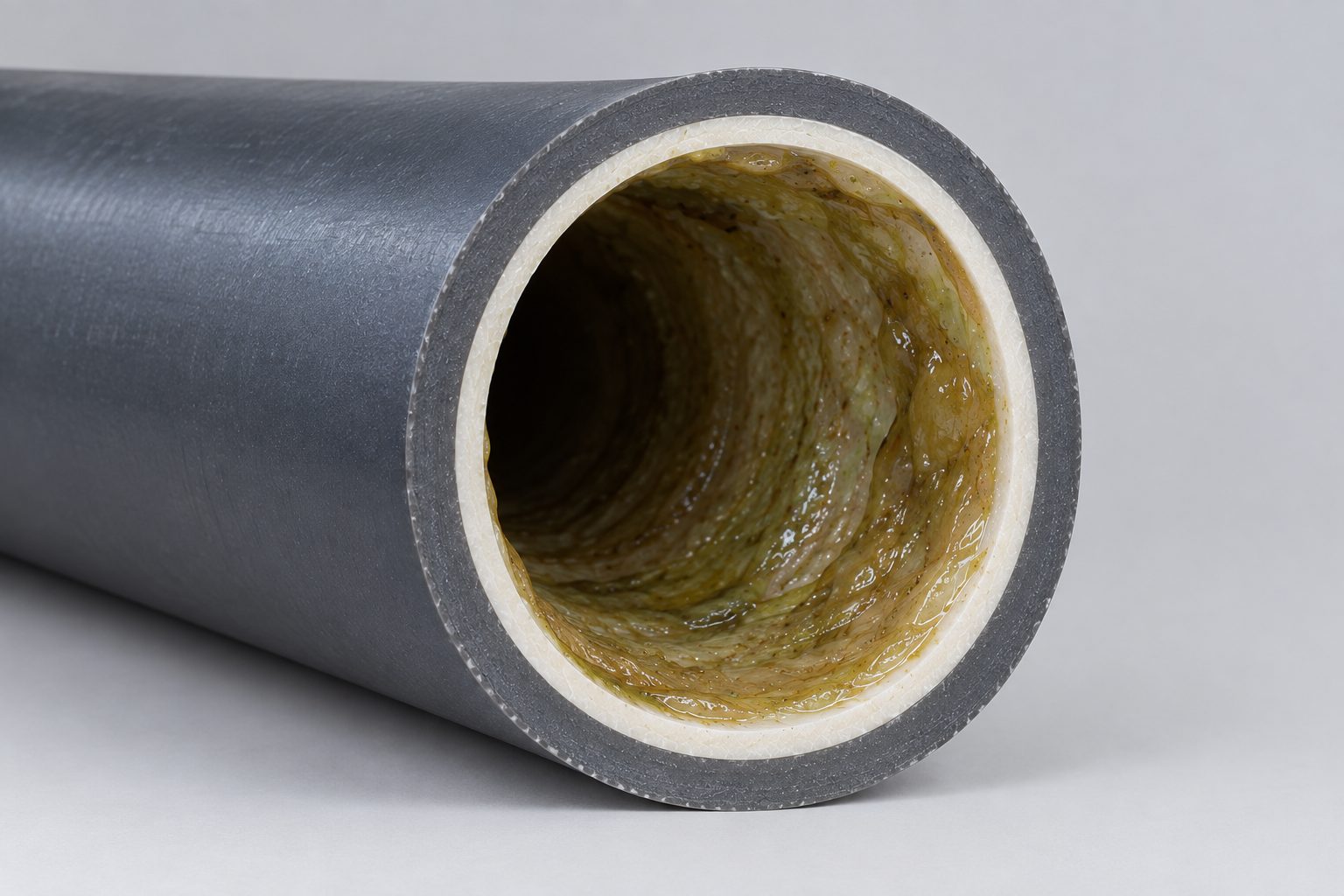
You have the pipes disinfected, the sample taken afterwards is fine, and two weeks later the bacteria are back. Often in even greater numbers than before. It is one of the most frustrating situations in water treatment, and it is rarely the fault of the disinfectant. The cause lies in what stays behind in the pipes after disinfection: the biofilm.
This applies to sanitary pipes in a building just as much as to process water in the food industry or the drinking water lines in a livestock barn.
What is a biofilm?
A biofilm is a slimy layer on the inner wall of pipes, buffer tanks and taps. Bacteria attach themselves to the surface and produce a protective matrix of sugars, proteins and other substances, known as EPS (extracellular polymeric substances). Inside it they live together, sheltered from flow, temperature fluctuations and disinfectants. Pathogens such as Legionella and Pseudomonas find an ideal hiding place there.
What is often underestimated is how much that layer contains. An estimated 95% of all micro-organisms in a water distribution system live in the biofilm, and only a small share floats freely in the water itself (Wingender and Flemming, 2004). A water sample therefore only shows the tip of the iceberg.
Why disinfection does not reach the biofilm
A disinfectant first has to get through that protective matrix before it can reach the bacteria. On the way, it reacts with the organic matter in the slime layer and is used up. As a result, often only a fraction of the original concentration reaches the deeper layers of the biofilm.
That explains why bacteria in a biofilm are so much harder to kill than bacteria floating freely in the water. The literature reports differences of up to 1,500 times more resistance to biocides (Sauer et al., 2007). Chlorine is a typical example: a strong but poorly selective oxidant that reacts with almost everything it meets and is therefore already consumed at the outer surface of the biofilm.
Killing is not the same as removing
This is the heart of the problem. Disinfection that kills the bacteria at the surface often leaves the biofilm itself in place. The dead cells and the matrix remain stuck to the pipe wall.
That leftover biomass is not a harmless residue: it is food. In laboratory research with drinking water, Nocker et al. (2021) found that after thermal or chemical disinfection, bacteria were back at their original level within five to seven days. After fourteen days, their numbers were even 59 to 77% higher than in water that had not been disinfected at all. The surviving bacteria feed on the dead cells. The researchers conclude that disinfection is not only about killing, but just as much about removing that dead biomass.
In other words: disinfection that does not clean can even make a contamination worse in the short term.
Five reasons why the contamination comes back
- Leftover biomass. Dead cells and matrix stay behind and serve as a breeding ground for the survivors.
- Surviving bacteria deep in the biofilm. Whatever the disinfection does not reach starts growing again straight away.
- Dead legs and stagnation. In pipe sections where water flows little or not at all, the disinfectant never arrives, while the biofilm keeps growing undisturbed.
- A dose that is too low or interrupted. A concentration that just fails to kill bacteria selects the most tolerant species. Pseudomonas aeruginosa is known for this increased tolerance in biofilms.
- Detaching pieces of biofilm. Pressure fluctuations or a sudden increase in flow cause fragments to break loose and form a new colony elsewhere in the network (Choi and Morgenroth, 2003).
How do you prevent the biofilm from coming back?
A lasting result takes two steps, in this order.
First remove the biofilm, don't just disinfect
A thorough cleaning or shock disinfection must actually loosen the biofilm from the pipe wall, so that the dead biomass is also flushed out of the system. This is where things most often go wrong: the system is disinfected, but not cleaned.
Then protect continuously with a low dose
Once the pipes are clean, a continuous, low dose prevents the biofilm from building up again. The disinfectant must then remain effective all the way to the last tap, not only just after the dosing point.
Chlorine dioxide is particularly well suited to both steps. It is a selective oxidant that does not react with every organic substance, so it is consumed less quickly than chlorine. Because it remains present in the water as a dissolved gas, it penetrates the biofilm and loosens it. Read more in our article How does chlorine dioxide work?
Practical measures
In addition, a few simple measures make a big difference:
- Remove dead legs and avoid stagnation by flushing regularly.
- Measure water quality at the taps, not only at the incoming supply.
- Monitor the disinfectant residual, so you know it is working all the way to the end of the pipe.
At Konax® we always work in that order: first remove the biofilm, then protect the installation continuously and monitor it online, so that a deviation is reported before it becomes a problem.
Frequently asked questions
How quickly does biofilm come back after disinfection?
Often within a few days. In research, bacteria were back at their original level within five to seven days after thermal or chemical disinfection when the dead biomass was not removed.
Why doesn't chlorine work well against biofilm?
Chlorine reacts with almost all organic matter it encounters and is therefore already consumed at the outer surface of the biofilm. The bacteria in the deeper layers are hardly reached.
Is a good sample after disinfection a guarantee?
No. A sample mainly measures the bacteria floating freely in the water, while the vast majority live in the biofilm on the pipe wall. A good result just after disinfection says little about the situation two weeks later.
How do I remove a biofilm for good?
By first effectively loosening and flushing out the biofilm, and then protecting the pipes continuously with a low dose of a product that remains effective up to the tap. A one-off disinfection is rarely enough.
Does flushing help against biofilm?
Flushing prevents stagnation and slows down build-up, but it does not remove an existing biofilm. That requires a cleaning treatment.
See also related articles
For more information, send your question to info@konax.com or speak with our specialists at the following number: +32 (0)51 31 43 93
← Back to all articles